Real-World Circularity:
The PSS-Pass Industrial Pilots
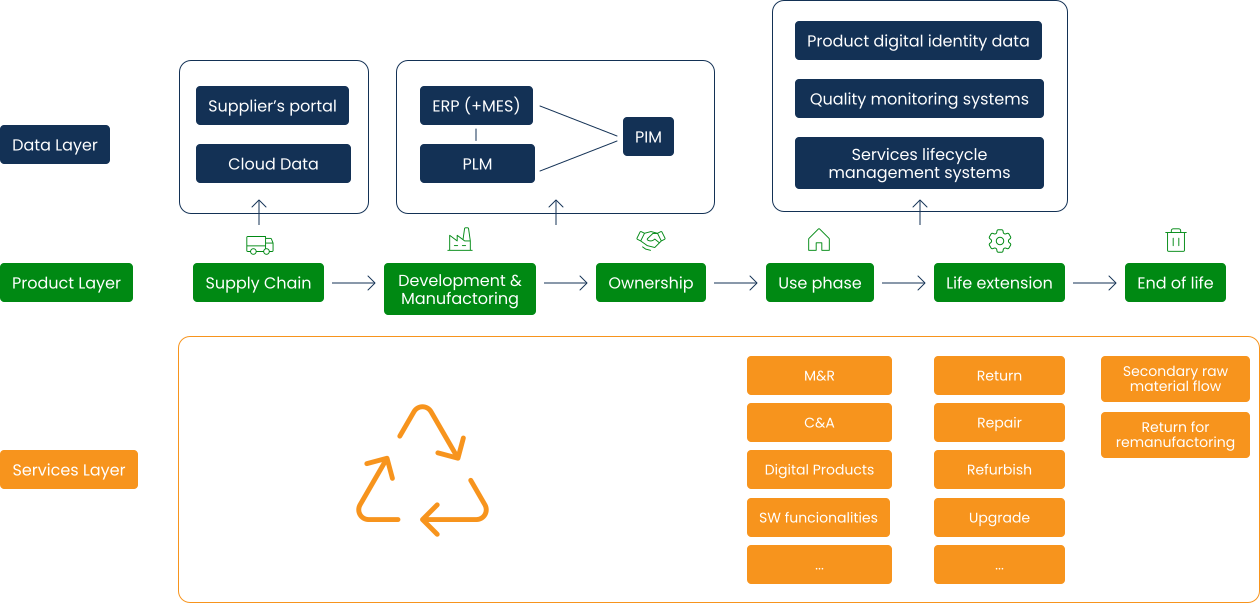
While standard Digital Product Passports (DPP) provide static snapshots of product data at manufacture, the Digital Product Service System Passport (DPSSP) continuously records dynamic operational, maintenance, and circularity data throughout the asset’s lifecycle.
To validate DPSSP across distinct value chains, PSS-Pass deploys three real-world pilots across different lifecycles and business models, demonstrating measurable reductions in carbon footprints, minimized downtime, and extended asset longevity.
PILOT 1
Home Appliances
The Business & Technical Challenge
Home appliance manufacturers face the challenge of transitioning from manufacturing-centric supply chains to extended Product-Accessories-Consumables-Services (PACS) ecosystems. Ensuring data governance, interoperability across multiple service providers, and accurate tracking of maintenance history while protecting the legitimate interests and intellectual property of the various value-chain actors are critical challenges.
The PSS-Pass Solution
By establishing a continuous product digital identity, DPSSP automatically evaluates a product’s health and usage history to unlock extended warranties, trigger predictive repairs before breakdown, and enable over-the-air (OTA) software functionality downloads that extend appliance life.
Partners
ELECTROLUX
Leads the pilot deployment and assessment, providing product and service (Maintenance and Repair) data and making it available within the DPSSP digital environment, thereby enabling the activation of value-added services such as warranty extensions, refurbishment programmes, OTA upgrades, and similar offerings.
ENGINEERING
Electrolux’s legacy systems (as raw data). The simulation primarily targets Maintenance and Repair service KPIs, as well as Product lifecycle management KPIs, including those related to Accessories Consumables, and Service lifecycle management.
UNPARALLEL
Provides the underlying Asset Administration Shell (AAS) microservices environment for the secure storage and sharing of appliance and service data.
Tecnalia
Supports the evaluation of the pilot’s environmental impact data [AC1.1][CV1.2] and contributes to the adaptation of application-level ontologies for home appliances.
University of Bergamo
Co-develops application-level ontologies and human-centric decision-making frameworks tailored to the white goods sector.
The Open Group
Manages the evaluation methodology, including criteria and ranking mechanisms. From a methodological perspective, it safeguards the integrity of the PSS-Pass solution from cybersecurity and ethical standpoints while ensuring a clear separation between service data associated with the user’s digital identity and service data related exclusively to the products.
ATB
Develops application-level ontologies and applies them through the semantic layer to access and manage data from Electrolux legacy systems, supporting DPSSP requirements for Digital Product Passport (DPP) and Product-Service System (PSS) data.
Restricting refurbishment services to products under verified maintenance schedules to ensure secondary-market quality.
Optimization of maintenance and repair KPI (planning routes and response times for instance) via Digital Twin simulation
PILOT 2
Complex plant engineering and production control systems
The Business & Technical Challenge
Industrial equipment often operates for 20 to 30+ years. However, after sale, product records become siloed or lost. Resale, reconfiguration, and secondary-market decisions suffer from price uncertainty, fraud risk, and lack of verified maintenance history.
The PSS-Pass Solution
Using Asset Administration Shell (AAS) standards (IEC63278) and high-frequency IoT sensor data (vibration, temperature, pressure leakage), Pilot 2 establishes a live, sovereign lifecycle record. This enables real-time Product Carbon Footprint (PCF) batch calculations, AI-driven predictive maintenance, and certified reconfiguration consulting.
Partners
OAS AG
Leads the pilot by providing solutions specialised in the interplay of machine and plant engineering as well as materials-handling technology with the process control technology (e.g. for powder mixers and hopper scales) and operational data to test predictive maintenance and batch Product Carbon Footprint calculation.
UNPARALLEL
Deploys the sovereign, decentralized AAS microservices architecture to manage 30+ year machine data histories across supply chain partners.
ATB
Develops application-level ontologies, and applies the ontologies with a semantic layer to access OAS legacy systems and data lake. Support in the data analysis for development of AI models for equipment for predictive maintenance, and custom simulation components for complex machinery.
ENGINEERING
Connects Digital Twins based Simulation to OAS legacy system’s data to simulate Carbon Footprint indicators, machine health and wear-part lifespans.
Tecnalia
Adapts AI models to compute automated Predictive Maintenance of industrial machinery.
University of Bergamo
Supports pilot scenario alignment and user-story integration within the overarching Methodological Framework.
The Open Group
Leads testing scenarios’ methodology and verifies security protocols for cross-organizational data sharing.
Expected Results & Metrics
Reduction in unexpected breakdowns via predictive maintenance and wear-part tracking.
Costs saved maintenance and operational downtime costs.
Reduced creation time for batch-specific PCF reports.
Increased component reuse rate for second-life markets.
PILOT 3
Fashion & Textile Circularity
The Business & Technical Challenge
The fashion sector struggles with end-of-life garment disposal, lack of supply chain material traceability, and unoptimized take-back programs that rely on subjective manual sorting.
The PSS-Pass Solution
Pilot 3 embeds AI-driven Life Cycle Assessment (LCA) and Life Cycle Costing (LCC) directly into the garment design phase. By aggregating raw material supply chain data into the DPSSP, Desigual optimizes sustainable design choices (fiber selection, dyeing) and power a data-driven Take Back Program that routes returned clothes to reselling, targeted repair, or specialized recycling.
Partners
Desigual
Leads the pilot by validating the DPSSP within its retail Take Back Program to streamline data-driven sorting, reselling, and potentially enable garment repair.
Tecnalia
Leads the technical AI deployment for automated LCA/LCC computation and bi-objective eco-design optimization for garments.
ENGINEERING
Connects Digital Twins based Simulation to OAS legacy system’s data to simulate Carbon Footprint indicators, machine health and wear-part lifespans.
UNPARALLEL
Connects supplier raw-material data and customer usage data into the DPSSP digital repository.
University of Bergamo
Oversees pilot scenario definitions and integrates Industry 5.0 human/sustainability training aspects.
The Open Group
Establishes KPI evaluation criteria and aligns textile traceability metrics with EU standardization roadmaps.
Circular Economy Foundation
Analyzes legislative constraints and formulates circular business models based on the garment pilot outcomes.
ATB
Develops application-level ontologies, and applies the ontologies with a semantic layer to access Desigual legacy systems.
Expected Results & Metrics
Better informed sorting decisions based on recorded composition and usage data rather than manual guesswork.
Reduction in decision-making time during eco-design and raw material purchasing phases.
Increase in environmental impact assessment precision and eventual significant reduction in overall garment impacts.
Higher rate of returned garments redirected to EOL alternatives to recycling.